 VIRK Transport Services
12 hours ago in Other Services
High Authority Social Bookmarking Site for Australian SEO in 2026 - A2Bookmarks Australia
Welcome to A2Bookmarks Australia, your premier high-authority social bookmarking site designed for effortless content submission and visibility down under. Our platform offers a trusted, dedicated network for Australians to easily save, manage, and share their favorite web pages and URLs. As one of the most reliable Australian social bookmarking sites in 2026, we ensure your content stays relevant and indexed. Whether you're a business owner seeking to boost your local online visibility or an SEO professional needing quality link submission tools, A2Bookmarks is the solution. Instantly increase your brand authority and build meaningful Australian backlinks by submitting your content directly through our verified, active network. Connect with our community, utilize powerful bookmarking tools, and boost your digital presence with confidence. Optimize your content reach and SEO performance with targeted social bookmarking tailored for Australian audiences. Start submitting your links today!
20ft vs 40ft Container Transport in Melbourne: Which One Do You Need? virktransportservices.com.au
VIRK Transport Services
12 hours ago in Other Services
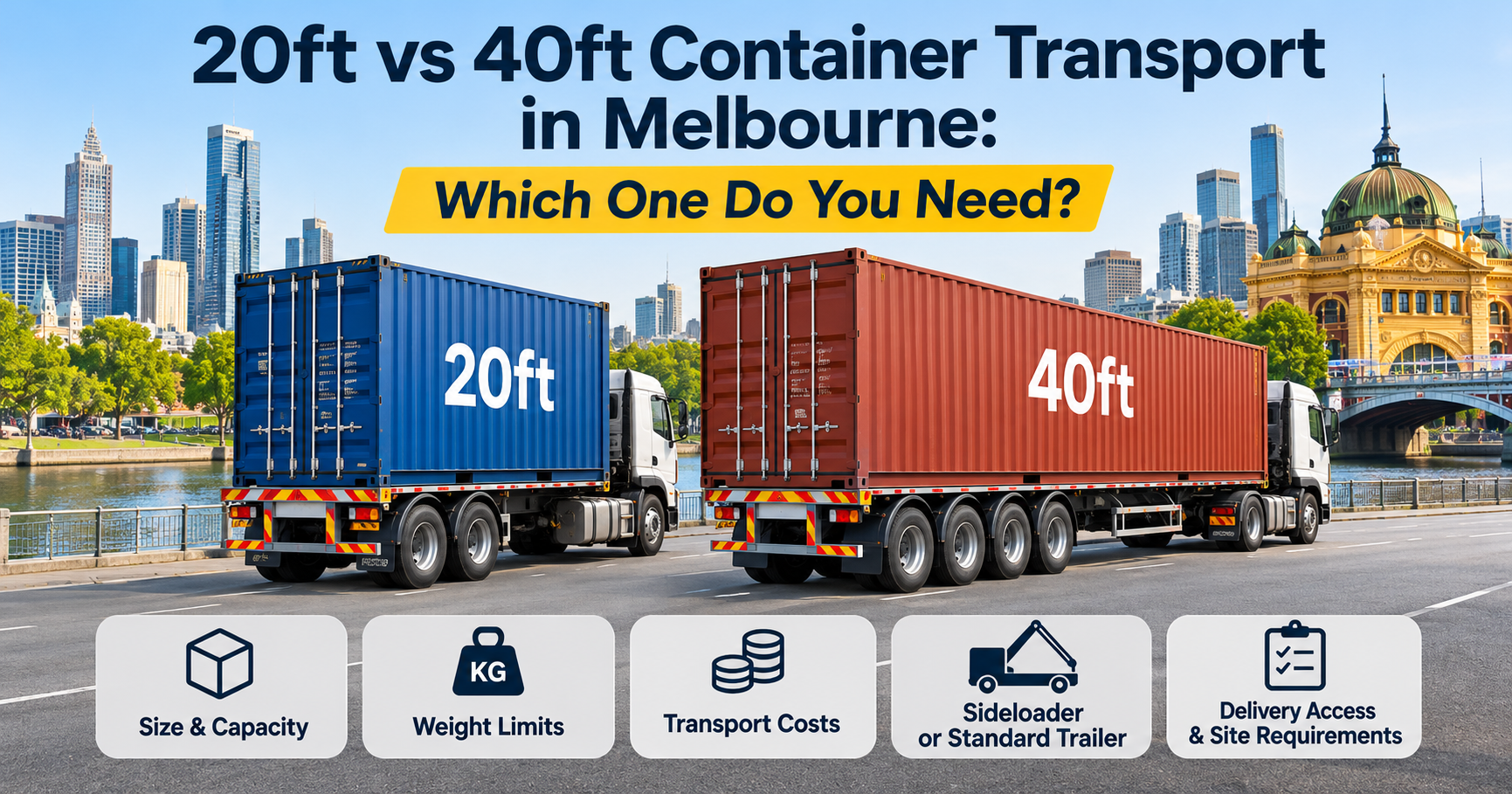
Choosing between a 20ft and 40ft shipping container can affect your freight costs, delivery arrangements and unloading process.
A 20ft container is often a practical choice for smaller shipments or heavy cargo. A 40ft container offers more room for large shipments, bulky products and higher cargo volumes.
But size is only part of the decision.
If you’re arranging container transport in Melbourne, you also need to consider cargo weight, truck access, unloading equipment and delivery costs.
This guide explains the main differences and helps you choose the right option for your shipment.
20ft vs 40ft Shipping Containers: Quick Comparison
Both container sizes are widely used for importing and exporting goods through the Port of Melbourne.
The main difference is the amount of cargo space available.
| Feature | 20ft Container | 40ft Container |
| External length | Approx. 6.06 m | Approx. 12.19 m |
| External width | Approx. 2.44 m | Approx. 2.44 m |
| External height | Approx. 2.59 m | Approx. 2.59 m |
| Internal capacity | Approx. 33.2 m³ | Approx. 67.7 m³ |
| Typical empty weight | Approx. 2.2–2.3 tonnes | Approx. 3.6–3.8 tonnes |
| Suitable cargo | Smaller or dense shipments | Larger or bulky shipments |
| Melbourne transport | Standard trailer or sideloader | Standard trailer or sideloader |
These are typical standard dry-container specifications. Actual measurements and weight ratings vary between containers.
A 40ft container provides slightly more than twice the internal volume of a 20ft container. However, it does not provide twice the legal carrying weight.
That difference matters when planning heavy shipments.
When Should You Choose a 20ft Container?
A 20ft container can be a good option when your cargo does not require the extra space of a 40ft unit.
It is commonly considered for smaller commercial shipments, machinery, building materials and dense products.
1. Your Cargo Is Heavy but Does Not Need Much Space
Some goods reach their weight limit before filling the container.
For example, a shipment of metal components weighing 18 tonnes might occupy only 15 cubic metres.
A 20ft container could provide enough room, depending on the cargo dimensions, weight distribution and container rating.
Using a larger container would not necessarily provide a transport advantage.
2. You Have a Smaller Shipment
If your cargo fits safely inside a 20ft container, there may be no reason to book a 40ft unit.
However, you should compare the total shipping and transport costs rather than assuming the smaller container will always be cheaper.
3. You Have Limited Delivery Space
A 20ft container takes up less ground space than a 40ft container.
This can help at smaller warehouses, industrial properties and sites with restricted container placement areas.
Keep in mind that the delivery truck may still be much longer than the container itself.
Best suited to: Smaller shipments, dense cargo and locations where container placement space is limited.
When Should You Choose a 40ft Container?
A 40ft container is useful when you need more cargo space.
It is often chosen for furniture, retail products, packaged goods and larger commercial shipments.
1. Your Cargo Takes Up More Space
Consider a shipment containing 50 cubic metres of lightweight packaged products.
This exceeds the nominal capacity of a standard 20ft container but falls within the nominal volume of a 40ft container.
The final loading plan must still account for packaging, pallets and unused space.
2. You Need to Move More Goods in One Shipment
A 40ft container can reduce the number of containers needed for high-volume cargo.
For example, a shipment that requires two 20ft containers might fit into one 40ft container.
This could reduce the number of container movements, although the total cost depends on freight rates, loading requirements and local transport charges.
3. Your Business Receives Regular Large Shipments
Businesses importing large quantities of products may benefit from planning shipments around 40ft containers.
Before choosing one, confirm that the warehouse has enough space for the truck and the required unloading equipment.
Best suited to: Large shipments, bulky products and businesses moving high volumes of goods.
What About a 40ft High Cube Container?
A 40ft high cube container has approximately the same length and width as a standard 40ft container but is about 30 cm taller.
It provides around 76 cubic metres of internal space compared with approximately 68 cubic metres in a standard 40ft container.
This extra height can help with tall or bulky cargo.
However, a high cube container also requires a suitable trailer and adequate height clearance along the delivery route and at the site.
It is not automatically the best choice for heavy cargo.
How Much Does 20ft vs 40ft Container Transport Cost in Melbourne?
Container transport prices in Melbourne depend on more than the size of the container.
A 20ft container is not always cheaper to transport than a 40ft container.
Both may require similar truck movements, terminal bookings and empty-container return arrangements.
Factors That Affect Container Transport Costs
Delivery location
Transport from the Port of Melbourne to a nearby industrial area may cost less than a longer trip to a regional Victorian destination.
Container weight
Heavy containers may require different equipment, additional planning or a surcharge.
Trailer type
A standard skeletal trailer and a sideloader perform different jobs. The equipment needed can affect the transport quote.
Terminal and booking charges
Terminal-related charges and booking fees may form part of the total transport cost.
Empty container return
For imports, the empty container usually needs to be returned to the location nominated by the shipping line.
Waiting time
Delays during loading or unloading may lead to detention charges when the agreed free time is exceeded.
How to Compare Quotes Properly
Ask transport providers to confirm whether the quote includes:
- Port and terminal-related charges
- Fuel levy and tolls
- Sideloader service, if required
- Empty-container return
- Heavy-container surcharges
- Waiting-time allowances
- GST
A low initial transport rate may not represent the lowest final cost.
Standard Trailer vs Sideloader: Which Delivery Method Do You Need?
Choosing the right trailer is just as important as selecting the container size.
Standard Skeletal Trailer
A standard skeletal trailer carries a shipping container on a purpose-built chassis.
It is suitable when the receiving site has the equipment needed to unload the cargo or lift the container.
For example, a warehouse with a loading dock may unload cargo directly from a container that remains on the trailer.
A skeletal trailer does not normally place the container on the ground by itself.
Sideloader Delivery
A sideloader uses hydraulic lifting equipment to place a container onto the ground beside the truck.
This can be useful when the receiving site needs the container to remain on the ground for unloading.
Both 20ft and 40ft containers can be transported using suitable sideloader equipment.
However, the site needs enough room for the vehicle, stabiliser legs and container placement.
Quick Delivery Comparison
| Delivery requirement | Suitable option |
| Warehouse can unload from a trailer | Standard skeletal trailer |
| Container must be placed on the ground | Sideloader |
| Site has a suitable container crane | Standard trailer may be suitable |
| Container must stay on site for unloading | Sideloader may be suitable |
| Very heavy container | Requires equipment and route assessment |
The best delivery method depends on the container’s gross weight, site access and unloading arrangements.
Container Weight Limits: What Melbourne Businesses Should Know
A common mistake is assuming that the maximum weight printed on a shipping container is also the maximum weight allowed on a truck.
These are different limits.
A container may be rated to carry a particular amount of cargo at sea, but its legal road transport weight depends on the truck, trailer, axle configuration and route.
Sideloader equipment may also have different lifting and carrying limits from a standard skeletal trailer.
Before booking, confirm:
- Cargo weight
- Container tare weight
- Total gross container weight
- Delivery equipment requirements
- Applicable road and vehicle mass limits
For heavy shipments, ask the transport provider to confirm whether the movement can be completed using its available equipment.
Melbourne Container Delivery: Check Site Access Before Booking
A container that fits your cargo may still be difficult to deliver to your property.
Before arranging delivery, consider the following.
Is There Enough Room for the Truck?
A truck transporting a 40ft container needs enough room to enter, turn and leave safely.
The required space depends on the truck and trailer configuration.
Are There Overhead Obstructions?
Power lines, trees, building structures and low entrances can restrict delivery access.
High cube containers may need additional height clearance.
Is the Ground Suitable?
Sideloader stabilisers need a suitable supporting surface.
Soft, uneven or sloping ground may make ground placement unsafe.
Can the Container Be Unloaded on Time?
If the container remains on the truck while being unloaded, confirm that the receiving site has staff and equipment ready.
Delays can affect the truck’s schedule and may result in additional charges.
Providing site photographs and delivery instructions before booking can help the transport operator assess access.
Practical Examples: Which Container Should You Choose?
The following examples are illustrative, not actual customer case studies.
Example 1: Heavy Machinery Parts
Cargo: 18 tonnes occupying 14 cubic metres.
A 20ft container may provide sufficient internal space.
The key checks are the dimensions of individual items, safe weight distribution and the legal road transport arrangement.
Example 2: Furniture Shipment
Cargo: 48 cubic metres of packaged furniture.
A standard 40ft container is the more practical starting point because the shipment exceeds the nominal capacity of a 20ft container.
The final choice depends on the loading plan and packaging.
Example 3: Warehouse Without a Container Crane
Cargo: One loaded 40ft container requiring ground-level unloading.
A sideloader may be appropriate if the cargo weight and delivery site are suitable.
The transport provider should check the access and placement requirements before confirming delivery.
Example 4: Small Import Shipment
Cargo: 12 cubic metres of commercial goods.
A 20ft container has sufficient nominal volume, but a full container may not be the most economical shipping arrangement.
The importer should also compare less-than-container-load (LCL) freight options before deciding.
Five Common Mistakes When Choosing Container Transport
Mistake 1: Choosing by container length alone
Always consider both cargo volume and gross weight.
Mistake 2: Assuming a 40ft container carries twice the weight
It offers roughly twice the volume, not twice the payload.
Mistake 3: Booking a standard trailer when ground placement is required
Confirm whether a sideloader or other lifting equipment is needed.
Mistake 4: Ignoring delivery access
Check gates, turning space, overhead clearance and ground conditions.
Mistake 5: Comparing transport quotes without checking inclusions
Confirm the complete charge structure before booking.
What Information Do You Need for a Container Transport Quote?
To receive a more accurate quote for 20ft or 40ft container transport in Melbourne, prepare these details:
- Container size and type
- Import or export movement
- Pickup and delivery locations
- Gross container weight
- Expected delivery date
- Standard trailer or sideloader requirement
- Loading or unloading arrangements
- Site access restrictions
- Dangerous goods or other special requirements, if applicable
Providing complete information early can reduce delays and help the transport provider select suitable equipment.
Final Thoughts: 20ft or 40ft Container Transport?
The right container depends on what you’re moving and how it will be delivered.
Choose a 20ft container when your shipment is smaller, relatively dense or does not require extra internal space.
Choose a 40ft container when you need more room for bulky products or larger shipments.
Before confirming transport in Melbourne, check the total container weight, unloading method, site access and complete delivery cost.
Need a container transport quote in Melbourne?
Contact a Melbourne container transport provider with your container size, gross weight, pickup location and delivery requirements. Ask for a clear quote that identifies the transport service and any additional charges.
Frequently Asked Questions
Is a 20ft container cheaper to transport than a 40ft container in Melbourne?
Not always. Both sizes may involve similar truck movements and terminal-related charges. The final price depends on the delivery location, weight, trailer type and additional services.
Can a 20ft container carry more weight than a 40ft container?
A 20ft container may be better suited to dense cargo because of its smaller volume and lower empty weight. However, actual payload ratings and legal road limits must be checked for each movement.
Can a sideloader deliver both 20ft and 40ft containers?
Yes, suitable sideloader equipment can handle both sizes. The container weight, lifting capacity and delivery-site conditions must be confirmed.
How much space does a 40ft container provide?
A standard 40ft dry container has approximately 67.7 cubic metres of internal volume. A 40ft high cube provides around 76 cubic metres.
Do I need a sideloader for container delivery?
You may need one if the container must be placed on the ground and no suitable lifting equipment is available at the delivery site.
Can a 40ft container be delivered to a small warehouse?
Possibly. The transport operator needs to assess vehicle access, turning space, overhead clearance and unloading requirements.
What happens if my container is too heavy?
The transport provider may need different equipment, an approved heavy-vehicle arrangement or another handling solution. Additional charges may apply.
What is the difference between a 40ft standard and a 40ft high cube container?
A high cube is approximately 30 cm taller and provides more internal volume. Both have similar floor dimensions.
voters
Report Story 
Related Stories








Recent Stories