 Krishtina Josheb
1 year ago in Business Services
Krishtina Josheb
1 year ago in Business Services
High Authority Social Bookmarking Site for Australian SEO in 2026 - A2Bookmarks Australia
Welcome to A2Bookmarks Australia, your premier high-authority social bookmarking site designed for effortless content submission and visibility down under. Our platform offers a trusted, dedicated network for Australians to easily save, manage, and share their favorite web pages and URLs. As one of the most reliable Australian social bookmarking sites in 2026, we ensure your content stays relevant and indexed. Whether you're a business owner seeking to boost your local online visibility or an SEO professional needing quality link submission tools, A2Bookmarks is the solution. Instantly increase your brand authority and build meaningful Australian backlinks by submitting your content directly through our verified, active network. Connect with our community, utilize powerful bookmarking tools, and boost your digital presence with confidence. Optimize your content reach and SEO performance with targeted social bookmarking tailored for Australian audiences. Start submitting your links today!
The Ultimate Guide to Becoming a Teacher of Competitive Strokes austswim.com.au
Krishtina Josheb
1 year ago in Business Services
Are you passionate about swimming and eager to help athletes refine their technique? Becoming a teacher of competitive strokes is a rewarding career that allows you to work with swimmers of all levels, helping them perfect their form, improve speed, and gain confidence in the water. Whether you’re an experienced swim coach or just beginning your journey, this guide will walk you through everything you need to know to excel in teaching competitive strokes.
What is a Teacher of Competitive Strokes?
A teacher of competitive strokes is a swim instructor specializing in the four main strokes used in competitive swimming:
- Freestyle (Front Crawl): The fastest and most commonly used stroke in competitions.
- Backstroke: The only stroke swum on the back, requiring strong coordination and balance.
- Breaststroke: Known for its glide and powerful kick, requiring precise timing.
- Butterfly: The most challenging stroke, demanding significant upper-body strength and endurance.
As a competitive strokes teacher, your focus is on perfecting technique, increasing efficiency, reducing drag, and enhancing speed, while helping swimmers develop stamina and race strategies.
Why is Teaching Competitive Strokes Important?
Technique is everything in competitive swimming. Even the strongest swimmers can fall behind if they have inefficient strokes. A knowledgeable coach can significantly impact a swimmer’s performance by:
Improving Speed & Efficiency: Small technique adjustments can lead to faster times and smoother strokes.
Reducing Injury Risk: Proper stroke mechanics minimize strain and prevent overuse injuries.
Building Confidence: Swimmers who master their strokes feel more prepared for competition and perform under pressure.
Enhancing Endurance: Teaching breathing techniques and efficient movements helps swimmers maintain stamina.
Teaching competitive strokes requires precision, patience, and practice—and the right guidance makes all the difference.
How to Become an Expert in Teaching Competitive Strokes
If you want to be a great teacher of competitive strokes, you need to develop both technical knowledge and coaching skills. Here’s how you can get started:
1. Master the Fundamentals of Each Stroke
Before teaching others, you must perfect your own understanding of stroke mechanics, including:
- Correct body position to minimize drag.
- Pull and kick techniques specific to each stroke.
- Proper breathing patterns to maximize oxygen efficiency.
- Understanding race strategies, such as starts, turns, and finishes.
Tip: Watch high-level swimmers (e.g., Olympic athletes) and analyze their technique to see what makes them efficient.
2. Get Certified in Swim Coaching
Most competitive swim programs require coaches to be certified. Consider obtaining one of these recognized certifications:
USA Swimming Coach Certification: Covers stroke mechanics, training principles, and coaching ethics.
American Swimming Coaches Association (ASCA) Levels 1-5: Provides progressive training for advanced coaching skills.
Red Cross Water Safety Instructor (WSI): Ideal for those teaching both beginner and competitive swimmers.
Swim England Coaching Certifications: Widely recognized in the UK for coaching development.
Certification not only gives you credibility but also teaches proper training methodologies and safety protocols.
3. Use Video Analysis to Improve Technique
Many elite coaches use slow-motion video analysis to identify stroke flaws. A simple smartphone or an underwater camera can help:
Identify stroke inefficiencies (e.g., poor hand entry, incorrect kick timing).
Track progress over time by comparing before-and-after videos.
Provide visual feedback to help swimmers understand their mistakes.
Tip: Apps like Coach’s Eye or Hudl Technique allow you to analyze swimmers’ strokes in detail.
4. Implement Effective Drills for Each Stroke
Drills are essential for refining technique and breaking bad habits. Here are some of the best drills for each stroke:
- Freestyle: “Catch-Up Drill” – Helps swimmers focus on a long, efficient stroke.
- Backstroke: “6-Kick Switch Drill” – Improves rotation and balance.
- Breaststroke: “Pull & Glide Drill” – Teaches correct timing and reduces resistance.
- Butterfly: “One-Arm Drill” – Helps swimmers isolate and refine their stroke movement.
Key Rule: Always focus on quality over quantity—perfect strokes at slow speeds before increasing pace.
5. Develop a Personalized Coaching Approach
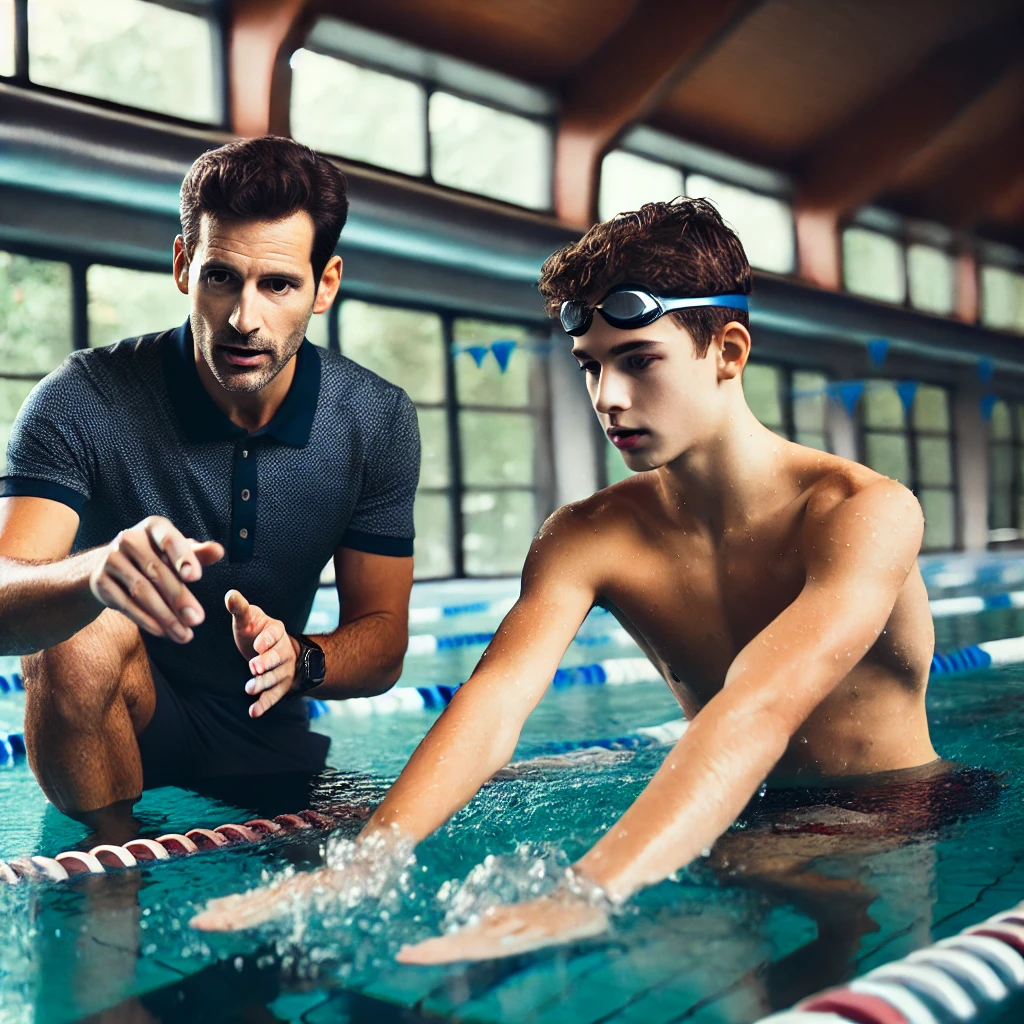
Every swimmer is different. Some respond better to verbal instructions, while others need hands-on demonstrations.
Young swimmers: Make learning fun with games and challenges.
Intermediate swimmers: Focus on technique correction and endurance.
Advanced swimmers: Fine-tune strokes and introduce race strategies.
Tip: Provide positive feedback and constructive criticism in balance—confidence is just as important as skill!
6. Teach Advanced Racing Strategies
Competitive swimming is not just about stroke technique—it’s also about race execution. Teach your swimmers:
Starts: Explosive push-offs and streamlined dives for a faster takeoff.
Turns: Quick and efficient flip turns for freestyle and backstroke, and open turns for breaststroke and butterfly.
Finishes: Timing and technique to touch the wall at maximum speed.
Pacing: Teaching swimmers how to conserve energy and sprint when needed.
Tip: Have swimmers practice starts, turns, and finishes repeatedly—these small details can be the difference between winning and losing.
Common Challenges & How to Overcome Them
Challenge: Swimmers struggle with endurance
Solution: Introduce breath control exercises and focus on consistent stroke tempo.
Challenge: Difficulty correcting bad habits
Solution: Use visual aids (videos, underwater mirrors) and slow-motion drills to break down movements.
Challenge: Swimmers get frustrated with slow progress
Solution: Celebrate small improvements, set realistic goals, and keep training engaging.
Challenge: Preventing injuries from repetitive motion
Solution: Encourage dryland training, stretching, and proper recovery techniques.
Final Thoughts: Make Waves as a Competitive Stroke Teacher
Becoming a teacher of competitive strokes is an exciting and impactful career. By mastering technique, using effective drills, and providing personalized coaching, you can help swimmers reach their full potential.
Focus on precision and efficiency in stroke mechanics.
Keep training engaging with video analysis and goal-setting.
Emphasize confidence-building and race strategies.
Adapt your coaching approach to meet each swimmer’s unique needs.
Are you ready to take your coaching skills to the next level? Start implementing these techniques today, and soon, you’ll be shaping the next generation of competitive swimmers!
What’s your biggest challenge when teaching competitive strokes? Share your thoughts in the comments below!
voters
Report Story 
Related Stories












Recent Stories